
Blog 7: How likely was it that waka could successfully travel from Polynesia to New Zealand and return?
- Kerry Paul

- Apr 18
- 3 min read
JOURNEY 1 - SERIES 1 - BLOG 7 - A PART OF 10 BLOGS IN SERIES 1 - Reading time: 3 Mins 30 Secs
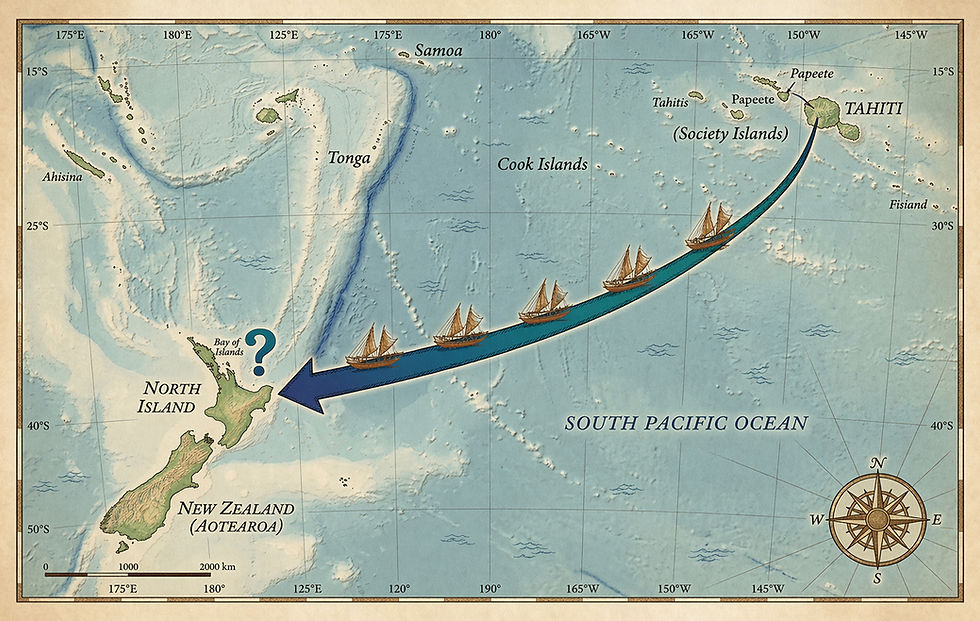
The evidence shows that a waka journey from Polynesia to New Zealand was fraught with severe environmental, navigational, and logistical risks, rendering successful arrival far from guaranteed.
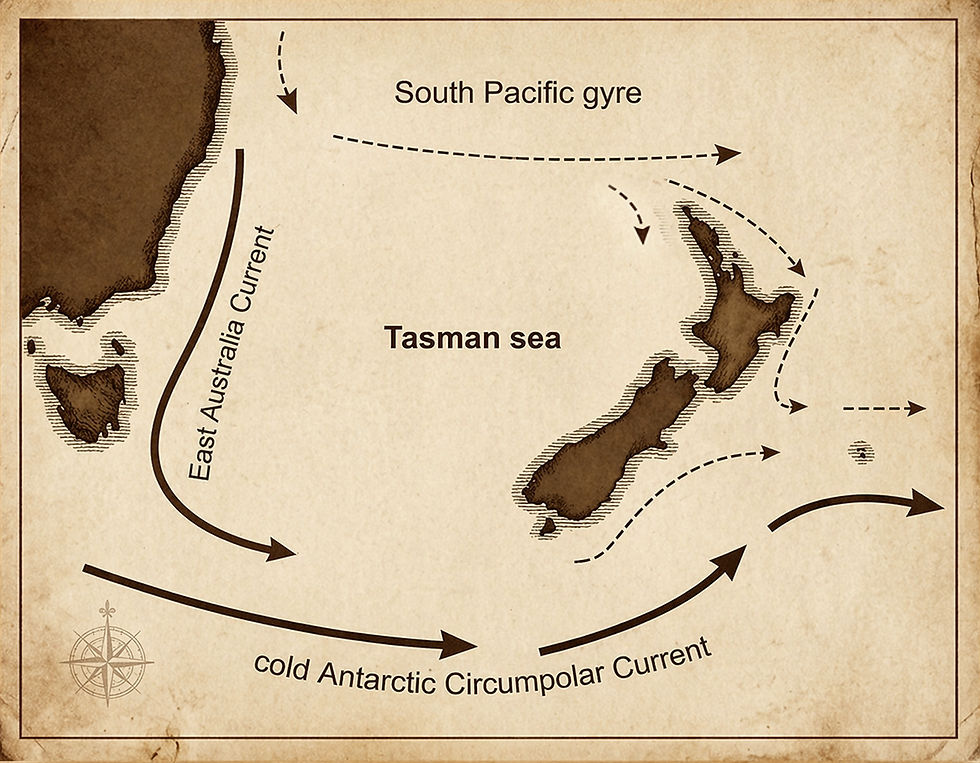
A primary issue was wind and ocean current direction. In the Southern Hemisphere, prevailing winds and currents do not naturally favour direct southward travel from central or eastern Polynesia to New Zealand. Trade winds dominate closer to the equator, while further south the westerlies and the Roaring Forties create powerful, often violent conditions. To exploit these systems, a waka would likely need to follow a long, indirect route rather than a straight course. This increased both journey length and exposure to storms, drift, and navigational error, complicating the Polynesian Migration to New Zealand.
Navigation itself posed a major constraint. Polynesian navigators could determine latitude with reasonable confidence using stars and the sun, but precise longitude was far more problematic. Without instruments capable of accurate timekeeping, small cumulative errors in direction or speed could result in missing New Zealand entirely. The challenge was not simply reaching southern latitudes,but locating a relatively small landmass in a vast ocean with no landmarks and no opportunity for correction once off course.
Provisioning and waka capacity further limited success. A journey from East Polynesia to northern New Zealand could take many weeks even under favourable conditions. Food and fresh water storage restricted crew size and endurance, while crew fatigue and illness increased risk over time. Larger crews increased consumption demands, reducing safety margins and making survival less likely if delays occurred.
Setting out on a waka voyage from Polynesia without knowing the length of time at sea involved substantial and unavoidable risk. Waka design and carrying capacity imposed strict limits on provisions, while navigation uncertainty meant landfall timing could not be reliably predicted. These constraints made over‑provisioning impractical and under‑provisioning potentially fatal. Regardless of whether new lands were already inhabited, such voyages remained low‑frequency, high‑risk undertakings, typically involving small crews and offering no dependable prospect of resupply or reinforcement from Polynesia.
Critically, return voyages were effectively blocked. Winds and currents that might carry a waka to New Zealand worked against any attempt to sail back to Polynesia. This meant that successful arrival was likely a one‑way event, eliminating the possibility of reporting success, refining routes, or reliably guiding later expeditions. Each voyage therefore carried enormous uncertainty, with no assurance that others would follow or even know its fate.
Taken together, these factors suggest that waka voyages to New Zealand were rare, high‑risk undertakings rather than routine migrations. Arrival required exceptional environmental knowledge, favourable conditions, and considerable luck, making the settlement of New Zealand an achievement shaped as much by risk and constraint as by navigational skill.
Key Takeaways
Voyages were high-risk and uncertain: Environmental conditions, including winds and currents like the Roaring Forties, made journeys long, indirect, and dangerous, with no guarantee of landfall in New Zealand.
Navigation limits reduced accuracy: While latitude could be estimated, the inability to measure longitude meant small errors could cause waka to miss their destination entirely.
Return journeys were highly unlikely: Prevailing winds and currents worked against travel back to Polynesia, making successful voyages effectively one-way events with no reliable route sharing.
This discussion adds another dimension to New Zealand’s origin story. These migration patterns contribute to broader debates surrounding Southeast Asian migration to New Zealand and are frequently compared with established interpretations of Polynesian migration to New Zealand. Together, these competing perspectives continue to shape ongoing discussions about New Zealand’s first settlers.
To continue reading the Series: Blog 8: Were Polynesian arrival numbers in New Zealand sufficient for long-term population survival?

Comments