
Blog 1: Beyond Polynesia: The Case for an Earlier Arrival in New Zealand
- Kerry Paul

- Apr 24
- 3 min read
Updated: Jun 30
JOURNEY 1 - SERIES 1 - BLOG 1 - A PART OF 10 BLOGS IN SERIES 1 - Reading time: 3 Mins 30 Secs

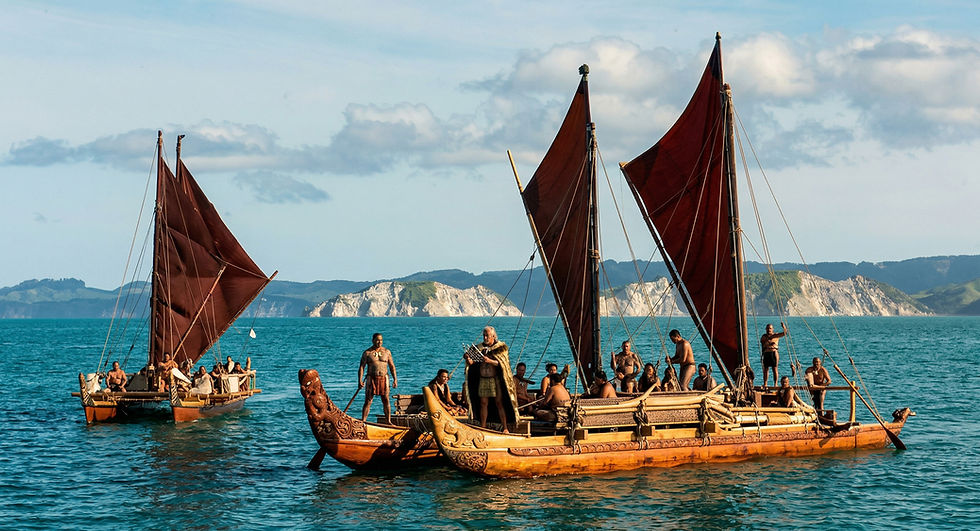
New Zealand lies within a broader region where humans had been established for over 60,000 years. Yet the prevailing view is that it was the last major landmass settled, only around 800 years ago, by Polynesian voyagers in double-hulled waka. This perspective assumes that no earlier populations had the capability to reach and settle New Zealand before that time.
However, thousands of islands across what is now called Southeast Asia and Melanesia were already inhabited many thousands of years ago. This raises the question: why did these populations not expand further south toward New Zealand? For many New Zealanders, Southeast Asia and Melanesia are often seen mainly through a modern lens, with limited awareness of the significant role these regions played historically. In reality, they were centres of population, innovation, and maritime activity for millennia, continuing to influence the wider world up to the present day.
Around 2000 years ago, Southeast Asia had reached a high level of development, with complex societies, expanding trade networks, with significant external influence from major civilizations such as India and China. Southeast Asia had become an important crossroads in regional and international trade networks, linking the Indian Ocean and the South China Sea. Traders exchanged goods such as spices, forest products, beads, textiles, and metals.

Indian and Chinese influences became increasingly visible. From India came religious ideas such as Hinduism and Buddhism, along with elements of language, art, and political organisation. Early forms of Indianised states began to appear, where local rulers adopted Indian-style titles and concepts of kingship to strengthen their authority. At the same time, contact with China, especially through trade and occasional diplomatic exchanges, contributed to cultural and technological exchange.

Technological development had advanced to iron tools becoming common, improving farming efficiency and craftsmanship. Advances in boat-building and navigation supported long-distance maritime trade, allowing Southeast Asian sailors to travel more widely and regularly.
Overall, Southeast Asia 2000 years ago was a region of growing complexity and connectivity. Its societies were more organised, economically active, and culturally dynamic, setting the stage for the rise of powerful kingdoms in the centuries that followed.
Compare this to the level in development in East Polynesia 2000 years ago, the region was largely unsettled by humans.
The distance from New Guinea to New Zealand is comparable to that from East Polynesia to New Zealand. However, travel from the Southeast Asian archipelago would have been significantly easier due to geography. The region offers numerous islands that enable shorter, staged voyages, along with the advantage of following the Australian coastline southward. In addition, the East Australian Current—flowing from the northern Queensland coast and branching toward New Zealand—provides a natural route that could assist navigation.
In contrast, the journey from East Polynesia to New Zealand involves crossing vast, uninterrupted stretches of open ocean, making long-distance navigation far more challenging. Overall, the route from the Southeast Asian archipelago to New Zealand presents a more accessible and less risky pathway than the direct voyage from East Polynesia.
In conclusion, the conventional narrative of New Zealand’s settlement invites closer scrutiny when considered alongside the broader patterns of human movement and development across the Pacific. The long-established populations of the Southeast Asian archipelago, their maritime capabilities, and the geographical pathways available to them raise important questions about the timing and origins of arrival in New Zealand.
The following Series of Blogs will present evidence to support the argument that people from the Southeast Asian archipelago reached New Zealand prior to the arrival of East Polynesian voyagers. Drawing on multidisciplinary evidence from archaeology, genetics, linguistics, and cultural studies, the content synthesizes current research to highlight deep historical connections between Southeast Asian societies and the earliest inhabitants of New Zealand. This research suggests Southeast Migration to New Zealand occurred earlier than Polynesian Migration to New Zealand. This discussion adds another dimension to New Zealand’s origin story. These migration patterns contribute to broader debates surrounding Southeast Asian migration to New Zealand and are frequently compared with established interpretations of Polynesian migration to New Zealand. Together, these competing perspectives continue to shape ongoing discussions about New Zealand’s first settlers.
To continue reading the Series: Blog 2: How credible is the view Kupe discovered New Zealand and returned to Hawaiki?


Comments