
Blog 5: What obstacles did the first Polynesians face on their journey to New Zealand?
- Kerry Paul

- Apr 20
- 3 min read
Updated: Jun 30
JOURNEY 1 - SERIES 1 - BLOG 5 - A PART OF 10 BLOGS IN SERIES 1 - Reading time: 3 Mins

A double-hulled waka could sail from East Polynesia to New Zealand, the estimated voyage time and scale can be demonstrated by a potential scenario. The sailing distance from Tahiti to northern New Zealand is approximately 4,000 km (about 2,160 nautical miles). At a realistic waka sailing speed of around 3 knots—roughly half the average speed of a modern sailing vessel—the voyage would require approximately 720 hours of continuous travel, equivalent to about 30 days at sea under best‑case, straight‑line conditions. These logistical hurdles are a vital part of the New Zealand origin story.
By comparison, a modern yacht travelling at 6 knots would complete the same distance in around 15 days.
These figures represent idealised minimum travel times for Polynesian Migration to New Zealand. In practice, Polynesian voyages would almost certainly have taken longer due to the need to follow prevailing wind belts and ocean currents rather than direct routes, as well as delays caused by weather, drift, leeway, and the need to manage sail and crew fatigue. Additional constraints—including limited water and food provisioning, the difficulty of sailing in heavy sea conditions, and the absence of precise longitudinal navigation—further increase the likelihood that real voyage durations exceeded these minimum estimates for New Zealand's first settlers.
Sailing south from Tahiti increased exposure to stronger winds and larger wave systems, especially when approaching the latitudes influenced by Southern Ocean weather patterns. A seaworthy waka needed to survive prolonged periods of rough conditions, not merely short storms.
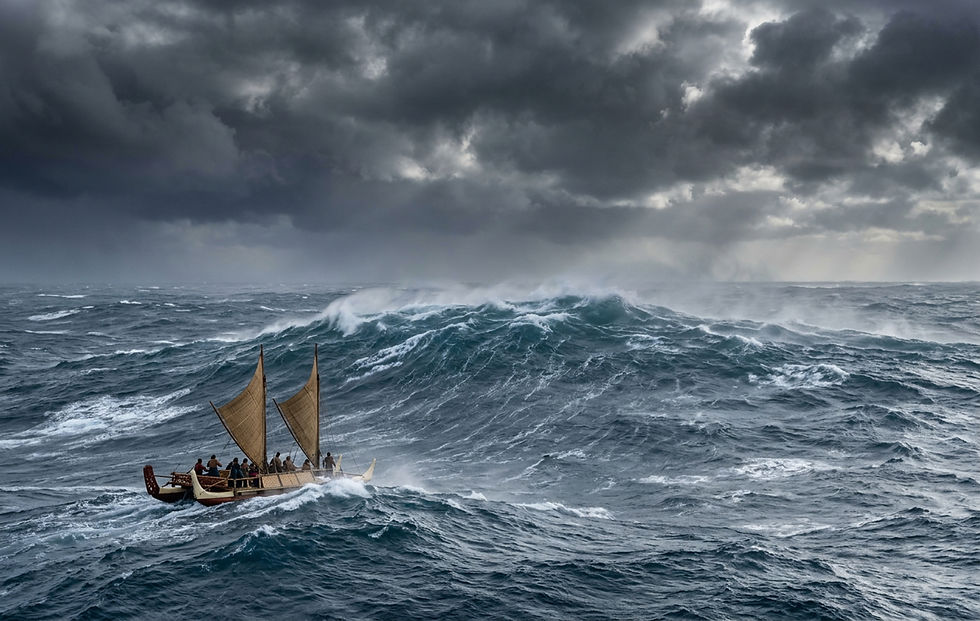
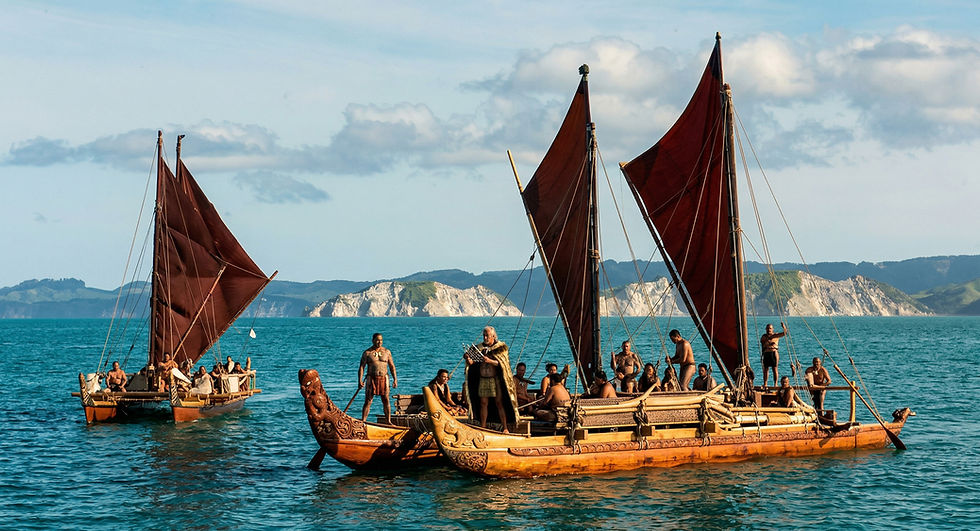
Ocean-going waka used crab-claw or lateen-style sails, which were highly efficient and could be reefed or adjusted as conditions changed. These sails allowed vessels to sail downwind with good control. Steering paddles and the ability to change heading relative to swell direction further enhanced survivability.
However, sailing directly upwind was not possible. At best, a waka could only make progress by sailing across the wind, often in directions that diverged significantly from its intended course. As a consequence, any return journey would become substantially longer, with the time required increasing dramatically. This in turn intensified the demands placed on provisioning, heightened crew fatigue, and compounded navigational risk. Under such conditions, successful voyaging would have depended heavily on accurate longitudinal navigation to correct for accumulated lateral drift and extended travel distances. Yet the navigational systems available at the time did not provide a reliable means of determining longitude with precision. These limitations in longitudinal navigation are examined in greater detail in the following blog.
Key Takeaways
Wind and sailing limits increased difficulty: Waka could not sail directly into the wind, forcing indirect routes that extended travel time and increased navigational uncertainty.
Survival challenges were significant: Limited food and water, crew fatigue, rough seas, and the inability to accurately determine longitude made long-distance voyages highly risky.
This discussion adds another dimension to New Zealand’s origin story. These migration patterns contribute to broader debates surrounding Southeast Asian migration to New Zealand and are frequently compared with established interpretations of Polynesian migration to New Zealand. Together, these competing perspectives continue to shape ongoing discussions about New Zealand’s first settlers.
To continue reading the Series:

Comments