
Blog 1: What are the sources of evidence for pre-Polynesian human inhabitation of New Zealand?

Updated: Jun 30
JOURNEY 1 - SERIES 4 - BLOG 1 - A PART OF 10 BLOGS IN SERIES 4. - Reading time: 3 Mins
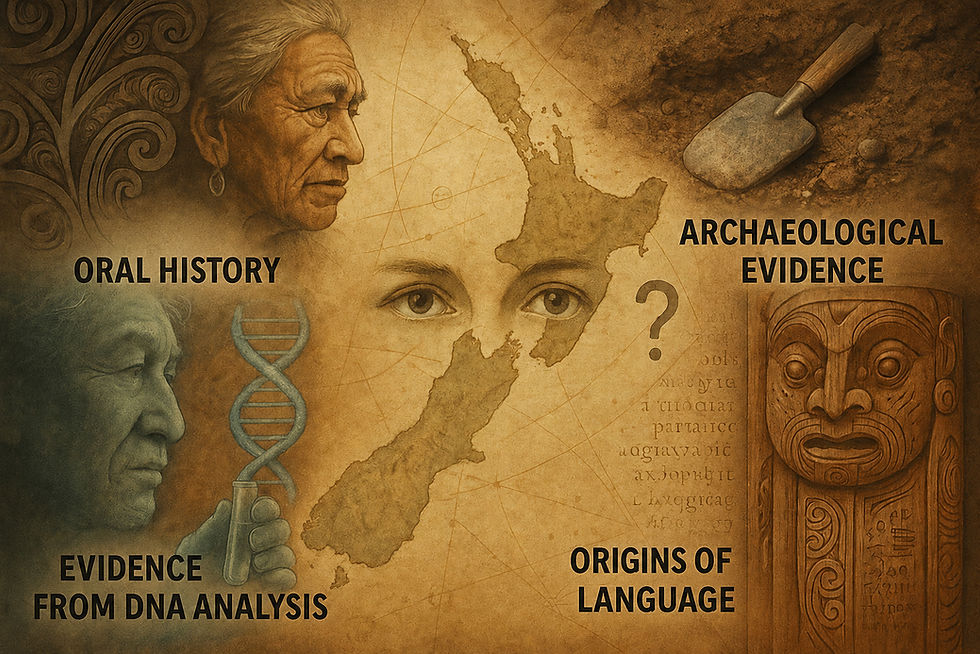
Establishing a credible case for pre-Polynesian human presence in New Zealand requires more than a single striking find or a lone tradition. It involves assembling all available information—material, linguistic, and historical—then weighing how well each strand of evidence supports earlier arrival or contact. Because the surviving record is incomplete, the task is partly one of probability: asking what patterns would be expected if people were here earlier, what traces would likely remain, and how alternative explanations (such as later transmission, misinterpretation, or natural processes) compare. Building the case therefore depends on triangulation—drawing cautiously from multiple, independent sources and looking for convergence between them. This discussion adds another dimension to New Zealand’s origin story. These migration patterns contribute to broader debates surrounding Southeast Asian migration to New Zealand and are frequently compared with established interpretations of Polynesian migration to New Zealand. Together, these competing perspectives continue to shape ongoing discussions about New Zealand’s first settlers.
The evidence can be categorised into the following areas:
Māori Oral History Evidence
Archaeological Evidence: Artefacts and Features
Origins of the Māori Language
Māori Oral History Evidence
Many European observers in the nineteenth century recorded accounts from Māori regarding pre-Polynesian settlers. During the second half of the 1800s, numerous European scientists visited New Zealand to study various aspects of the country and report their findings to European colleagues. Reports from 150 years ago may be considered more accurate than modern interpretations, as there was far less genetic diversity amongst the local population at the time. Early observers had a greater opportunity to note distinct differences between ethnic groups, recording their observations and comments from Māori counterparts in publications that are still read today.
Observations on Pre-Polynesian Inhabitation
Reports from several academics and scientists regarding pre-Polynesian inhabitation include:

Andreas Reischek
Andreas Reischek, an Austrian ornithologist, collected specimens in New Zealand from 1877 to 1889. Fluent in English and Te Reo Māori, he was a close friend of Tāwhiao, the second Māori King, who granted him freedom to explore the King Country. Reischek's notes were published in Yesterdays in Maoriland, where he documented conversations with Māori:
"The chiefs told me the Māori are a mixed race; tradition has it that their forefathers originally came to New Zealand from Hawaiki in 13 double canoes. They landed at different spots in the North Island and found them inhabited by dark-coloured men with curly black hair and small stature. These original inhabitants—they called them Ngātimaimai—were good husbandmen and hunters but poor warriors. So the Māori conquered them, killed the men, and took possession of the women. This union would account for the three different types I noticed." (Source: Page 197, Yesterdays in Maoriland, Andreas Reischek, 1924)
J.S. Polack
J.S. Polack, an Englishman who arrived in New Zealand in 1831, became fluent in Te Reo Māori and published two books: New Zealand: Being a Narrative of Travels and Adventures (Vols. I and II, 1838) and Manners and Customs of the New Zealanders (1840). His writings covered a wide range of topics related to the Māori people, including references to pre-Māori inhabitants.

John Macmillan Brown
John Macmillan Brown, a Scottish academic who arrived in New Zealand in 1874, served as a Professor of English and Classics at Canterbury College. In 1907, he published Māori and Polynesian: Their Origins and Cultures, in which he documented Māori accounts mentioning "fair-headed and fair-skinned" people who lived in New Zealand before the first Polynesians arrived.
William Colenso
William Colenso, a botanist and explorer fluent in Te Reo Māori, published On the Māori Races in 1868, arguing that the first "Māori" were remnants of an ancient race.
Key Takeaways
A credible case depends on triangulation, not a single “smoking gun.”
The evidence base is explicitly multi-source: oral history, archaeology, and linguistics.
Early recorded Māori traditions are treated as a key (but careful) line of evidence.
To continue reading Series 4 we invite you to join us:


Comments