
Blog 2: Māori Oral Traditions of Earlier Peoples in New Zealand

Updated: Jun 30
JOURNEY 1 - SERIES 4 - BLOG 2 - A PART OF 10 BLOGS IN SERIES 4. - Reading time: 3 Mins

Observations by Māori of Pre-Polynesian Settlers
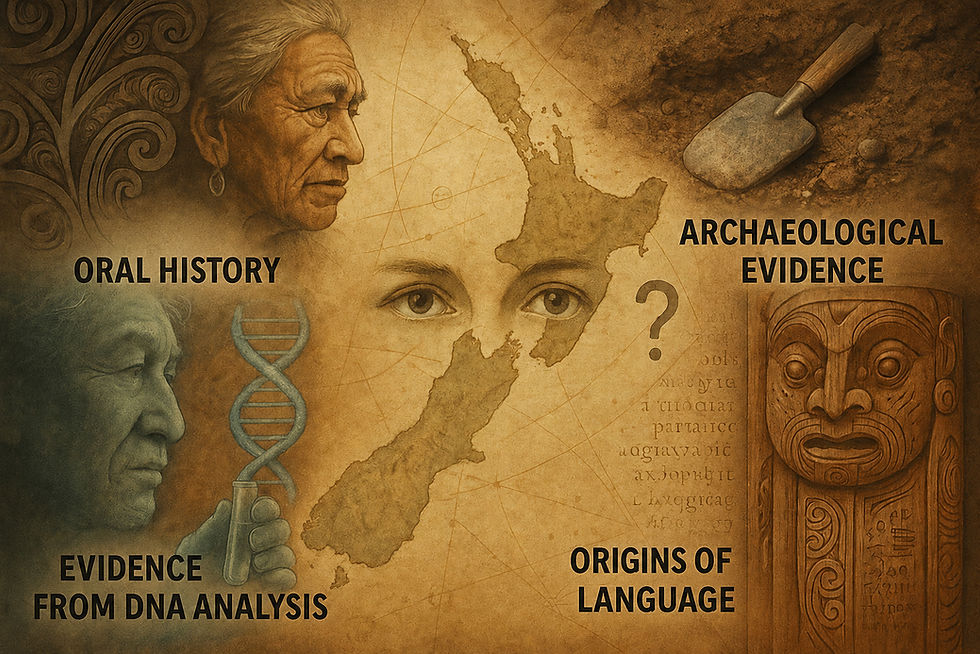
Many Māori traditions speak of Waitaha, Tūrehu, and Patupaiarehe as fair-skinned peoples who lived in New Zealand before later Polynesian arrivals. However, no arriving group could reliably claim to be the first, because New Zealand’s scale, rugged terrain, and dense vegetation would have made it difficult for newcomers to know whether other communities already existed elsewhere. This discussion adds another dimension to New Zealand’s origin story. These migration patterns contribute to broader debates surrounding Southeast Asian migration to New Zealand and are frequently compared with established interpretations of Polynesian migration to New Zealand. Together, these competing perspectives continue to shape ongoing discussions about New Zealand’s first settlers.
Two perspectives help explain how credible such accounts might be. First, any ship or waka arriving 800—or even 2,000—years ago would have been unlikely to know of earlier arrivals. The country spans roughly 1,600 km, has two long coastlines, and includes an interior of dense bush and difficult terrain, making movement and communication across regions challenging. As a result, a group landing in one area might never encounter people living elsewhere, or might meet them only much later and then interpret them as prior inhabitants.
Second, if a waka carrying Polynesian men landed in New Zealand and, as Andreas Reischek recorded in Māori accounts, encountered an established population, then conflict and assimilation could have erased that earlier group’s distinct identity. If the men of the earlier population were killed and the women incorporated into the new community, collective memory of the prior population could fade over generations. In that situation, the dominant group would likely shape the narrative of being the first arrivals.

A number of people in New Zealand claim descent from Waitaha, Tūrehu, and Patupaiarehe. Numerous books have been written on the subject, with some suggesting that many cultural elements commonly associated with Māori may have originated from these earlier inhabitants.
A notable text on this topic is Hawaikai: 2000 BC to Hokianga by Joan M. Leaf (1993). Leaf describes the migration of Waitaha from southern India (Hawaikai) to Borneo and, due to hostilities, their eventual departure from northern New Zealand around 3,000 years ago. Over time, the Waitaha gradually moved southward to Wellington. The work is largely a synthesis of tradition and genealogy presented as a continuous historical timeline with many references to pre-Polynesian inhabitants.
Dr Ranganui Walker stated in the 1986 New Zealand Yearbook, page 18, when Head of Maori Studies at the Auckland University, “The traditions are quite clear on one point, whenever crew disembarked there were already tangata whenua (prior inhabitants) living in New Zealand”.

This was endorsed by Ngapuhi Leader David Rankin when he stated in the Northern Advocate on the 27 December 2012, "If we believe our histories, then we as Maori are not the indigenous people of New Zealand. He pointed to numerous Maori oral histories which referred to people being here when the first Maori arrived, including fair-skinned people”.
The Rangitāne people, originally part of Ngāti Māmoe, included in their Treaty of Waitangi submission that their ancestors had intermarried with pre-Polynesian inhabitants.
Regardless of who the earliest settlers were, they were either assimilated into or eliminated by the later arriving Māori.
Key Takeaways
Māori oral traditions reference earlier peoples (Waitaha, Tūrehu, Patupaiarehe), but New Zealand’s scale and terrain mean later arrivals could not reliably know whether they were truly “first.”
Accounts of prior inhabitants can be explained by limited early contact between regions and by later encounters being interpreted as evidence of earlier settlement.
If an established population existed, conflict, assimilation, and intermarriage could have erased distinct identities over generations—while later groups shaped the dominant origin narrative.
To continue reading Series 4 we invite you to join us:


Comments