
Blog 1: Maritime Networks, Southeast Asia, and the Question of Early Human Presence in New Zealand?

Updated: Jun 30
JOURNEY 1 - SERIES 2 - BLOG 1 A PART OF 2 BLOGS IN SERIES. - Reading time: 4 Mins
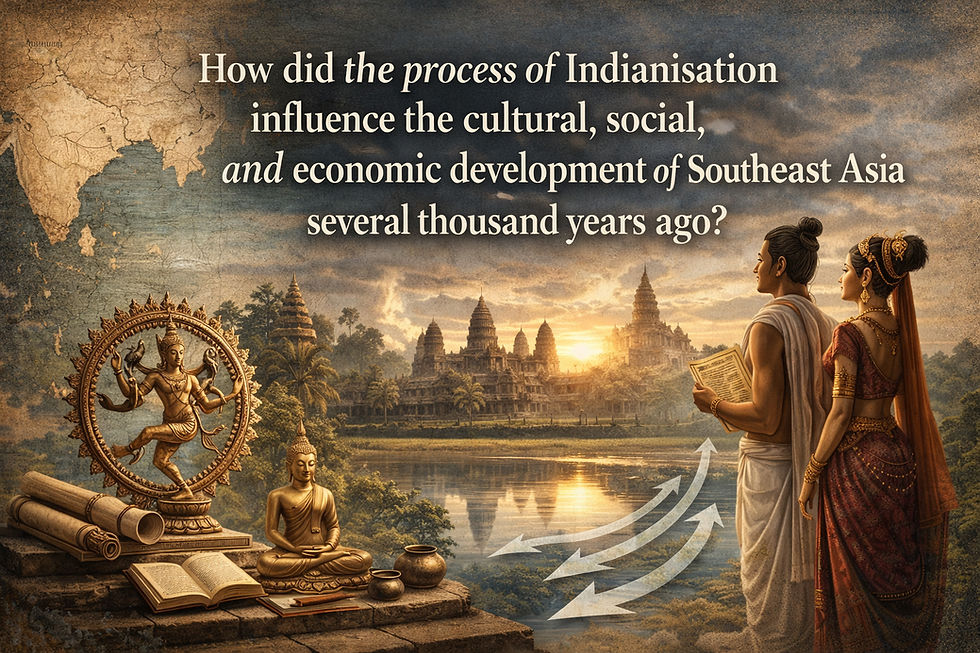
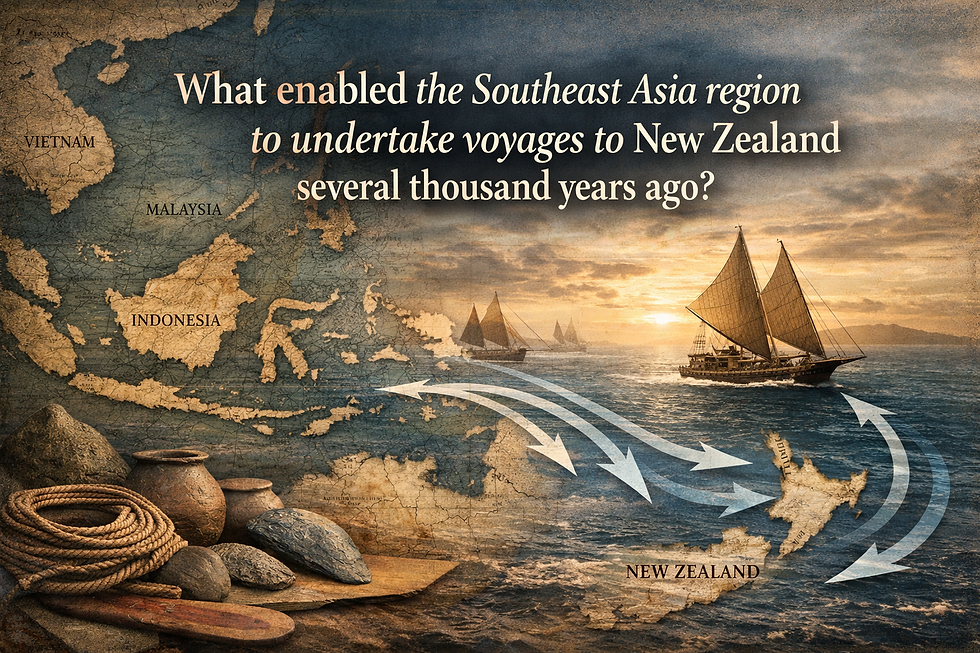
Did New Zealand really remain uninhabited by humans until 800 years ago? Exploration from Southeast Asia into the New Zealand region was a realistic and credible possibility.
The earliest civilizations in Southeast Asia emerged around 4000 years ago in mainland areas with agricultural societies developing bronze tools. These societies were vigorous and powerful engaging in distant maritime exchange, able to organise large-scale water control measures and maintained specialised bronze and iron workshops. This discussion adds another dimension to New Zealand’s origin story. These migration patterns contribute to broader debates surrounding Southeast Asian migration to New Zealand and are frequently compared with established interpretations of Polynesian migration to New Zealand. Together, these competing perspectives continue to shape ongoing discussions about New Zealand’s first settlers.
By at least 2,500 years ago, India and the coastal and riverine communities of Southeast Asia were engaged in substantial exchanges of ideas and goods. Monsoon-driven maritime networks allowed merchants, monks, scholars, and artisans to move between the two regions, carrying texts, rituals, architectural knowledge, and artistic motifs alongside spices and luxury goods. The Indians sailed large ships capable of carrying 500 to 1000 tonnes of cargo and people.
As traders moved across the region, they carried their religions with them. Hindu kingdoms emerged as early as 2,300 years ago, followed by Buddhist ones around 2,000 years ago. A close relationship developed between the traders and the newly established religious communities.
By 2000 years ago, a vast maritime trade network connected Rome, the Mediterranean, North Africa, the Indian Ocean, Indonesia, and China, with India at its centre. The Red Sea linked to the Mediterranean via a short overland route through Egypt, followed by ship transport along the Nile completed the network. Potentially Europeans could migrate to Southeast Asia by sea.

By 2000 years ago, formalized states appeared, with the coastal Funan kingdom in the Mekong Delta (Vietnam/Cambodia) widely considered one of the earliest large-scale, trade-focused civilizations.
New urban centres emerged in present-day Sri Lanka, Indonesia, Myanmar, Malaysia, Thailand, Laos, Vietnam, and Cambodia to facilitate trade with Indian merchants. These traders, carried eastward by the monsoon winds, brought cargoes of beads, textiles, and metal goods, which they exchanged for spices, camphor, resin, and other raw materials. They were also drawn to the region’s rich gold deposits, found in Sumatra, Sarawak, the Malay Peninsula, and parts of the mainland.
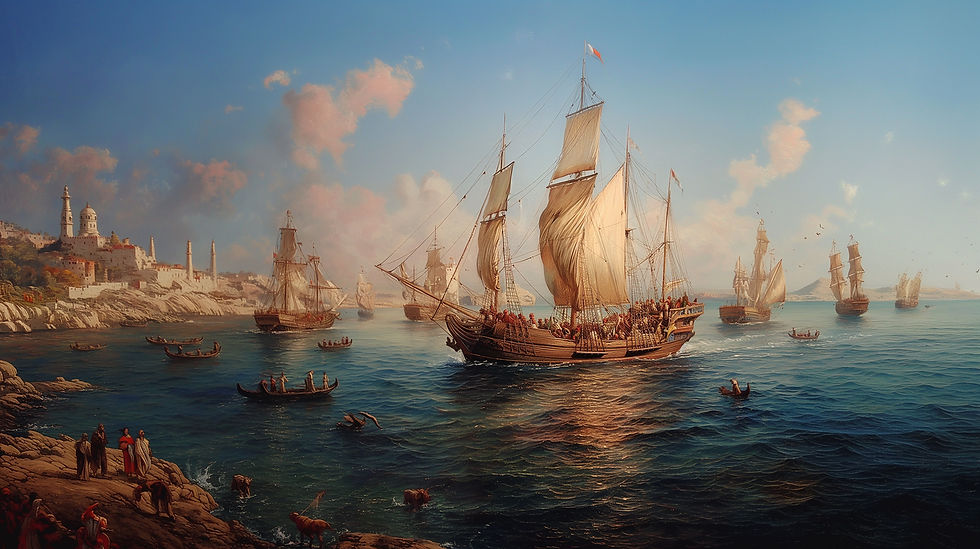
By the 5th century CE, a major sea route had been established through the Straits of Malacca, linking Indian traders directly to China. The summer monsoon facilitated a swift journey—taking approximately three weeks from Sri Lanka to Sumatra, and less than a month from there to Guangzhou.
Southeast Asia became a major hub of global trade, serving as a meeting point for Indian and Chinese merchants. The region evolved into a “melting pot” of diverse cultures. A striking example is Bali, a modern-day holiday destination that reflects a unique form of Hinduism resulting from this cultural blending.
India’s influence on Southeast Asia is profound, particularly through the spread of Hinduism and Buddhism. This influence is evident in the region's architecture, language, literature, and political systems. Iconic structures such as Angkor Wat in Cambodia and Borobudur in Indonesia showcase Indian architectural and cultural influence. This phenomenon is often referred to as the "Indianisation" of Southeast Asia, where local rulers adopted Indian concepts of kingship, statehood, and religious practices, integrating them with their own traditions. Just as importantly, the Indian maritime expertise expanded into Southeast Asia, opening up longer and more ambitious sea voyages than before.
Front view of Angkor Wat Temple in Cambodia Bird's eye view of Borobudur Temple in Indonesia
Key Takeaways:
New Zealand may not have been as isolated from early human exploration as traditionally believed.
Southeast Asia was home to advanced, outward‑looking civilizations thousands of years ago.
Extensive Indian Ocean trade networks enabled the large‑scale movement of people, ideas, and beliefs.
Comments