
Blog 2: New Zealand in World History: Migration, Oceans, and the Question of First Settlement

JOURNEY 1 - SERIES 2 - BLOG 2 A PART OF 2 BLOGS IN SERIES. - Reading time: 3 Mins 30 Secs
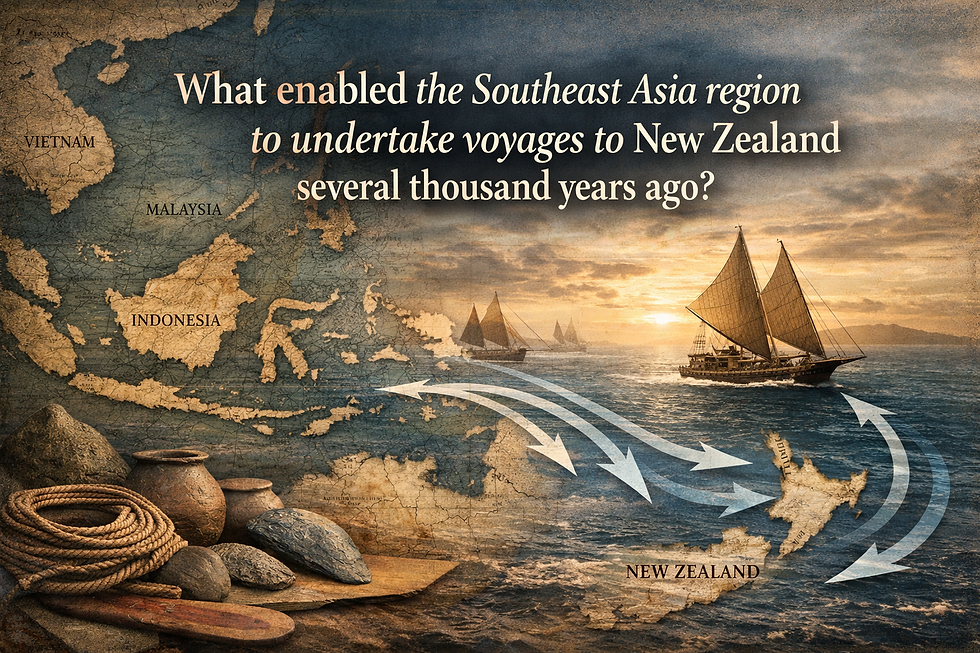
New Zealand’s closest neighbours were inhabited thousands of years ago, creating the conditions that eventually made the discovery of these southern islands possible. More than 2,000 years ago, sophisticated sea routes already existed that were capable of transporting large groups of people across vast distances. These maritime networks linked the Mediterranean world with India, Southeast Asia, and New Guinea. At the same time, populations from regions north of Southeast Asia were actively trading with and migrating into these interconnected areas. This discussion adds another dimension to New Zealand’s origin story. These migration patterns contribute to broader debates surrounding Southeast Asian migration to New Zealand and are frequently compared with established interpretations of Polynesian migration to New Zealand. Together, these competing perspectives continue to shape ongoing discussions about New Zealand’s first settlers.
Australia, Southeast Asia, and New Guinea themselves had been settled tens of thousands of years earlier by people who migrated out of northeastern Africa. Over long periods, these early populations interacted, intermarried, and adapted to new environments. Through continual movement and contact, distinct yet interconnected cultures emerged. Migration throughout human history has been driven by a shared desire for improved living conditions, greater security, and new opportunities.

Around 3,500 years ago, this movement of people expanded further eastward. Seafaring groups spread from Southeast Asia and the New Guinea region into Melanesia, laying the cultural and technological foundations that would later give rise to Polynesian societies. This expansion marked a significant phase in human exploration of the Pacific Ocean.

Southeast Asia has thousands of islands, with Indonesia and the Philippines being the largest archipelagos; while exact counts vary, Indonesia has around 6,000 inhabited islands out of over 17,000 total, and the Philippines has approximately 2,000 inhabited out of 7,000+ islands, contributing to the region's vast number of inhabited landmasses. The broader region includes major islands like Borneo and New Guinea, with numerous smaller islands supporting diverse cultures and ecosystems.

The Indonesia–New Guinea region itself comprises more than 17,000 islands, each home to its own ethnic groups and cultural traditions. Coastal communities, in particular, developed strong maritime skills and seafaring knowledge. These communities maintained extensive contact with neighbouring islands and welcomed voyagers from far beyond their immediate surroundings, fostering an enduring tradition of ocean travel that would ultimately make the settlement of the wider Pacific, including New Zealand, possible.
This raises the question: if the Southeast Asia/New Guinea region had emerged as a centre of civilisational activity, why was New Zealand left uninhabited until around 800 years ago? Who were actually New Zealand's first settlers? Given the scale of migration, trade, and seafaring capability in the wider region, New Zealand’s apparent lack of permanent settlement until relatively late invites explanation rather than assumption. Geographic distance, climate, technology, and cultural choices all become relevant factors in understanding when—and by whom—New Zealand was eventually settled.
Key Takeaways
New Zealand emerged at the edge of a world that was already deeply connected.
Southeast Asia and New Guinea formed a long‑standing centre of migration and seafaring expertise.
New Zealand’s late settlement raises historical questions rather than confirming isolation.
This completes Series 2: Southeast Asia Was Already Thriving 3000 Years Ago and we invite you to join us for Series 3: What Enabled Southeast Asian Peoples to Potentially Reach New Zealand Before Polynesians?
Comments