

BLOG 8: Can the origin of artefacts discovered in New Zealand be linked to Southeast Asia?
- Kerry Paul

- Mar 26
- 2 min read
Updated: Apr 13

Numerous artefacts originating from other countries—especially Southeast Asian nations—have been unexpectedly discovered in New Zealand. While it is evident that these items made their way to New Zealand, the exact means by which they arrived remains uncertain. Natural processes such as volcanic ash deposition, sediment movement, and the transformation of vegetation into humus can quickly conceal objects deep beneath the soil. Thanks to fortunate discoveries, several of these artefacts have come to light, and it is likely that much more evidence of early arrivals still lies hidden underground. A few examples are provided:
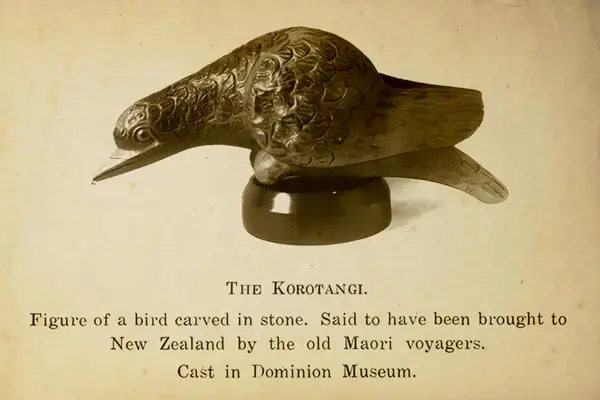
Serpentine Stone Bird Carving
In 1878, a finely carved stone bird made from dark green serpentine was discovered in New Zealand. The stone itself is not native to New Zealand, with the nearest sources found in Indonesia and China, and the craftsmanship indicates the use of metal tools. Since Māori in New Zealand and East Polynesia did not possess metal tools or the skills for such detailed stone carving, the most likely origin of the artefact is Southeast Asia where both serpentine stone and fine carving skills were present.
Tamil Bell/Cooking Vessel

The Tamil Bell is a bronze bell inscribed with Tamil script, acquired around 1836 by missionary William Colenso in New Zealand. Colenso was told that the bell had been discovered when a large tree was blown over during a heavy gale, revealing the artefact entangled in its roots. Its Tamil design indicates that it was crafted by people from Southern India or Sri Lanka. Second, it is made of bronze and shaped as a bell. This suggests it was manufactured either in India or Sri Lanka, as New Zealand had neither the bronze material nor the means to produce such an artefact. With the Indian maritime trade with Southeast Asia there is the distinct possibility this was its origin.
Polished Stone Tools

Julius von Haast (1822-1887) was a German-born New Zealand explorer, geologist, and founder of the Canterbury Museum in Christchurch. During his travels, he discovered polished stone tools in Westland.
First, in Bruce Bay, he found an adze below five metres of soil beneath 1000-year-old rimu trees. Gold miners, while digging nearly five metres deep for gold deposits, accidentally found a greyish sandstone chisel and a sharpening chisel close to each other.
Secondly, at Hunts Beach, he found a sandstone adze with a well-polished cutting edge six metres beneath an ancient forest.
Sandstone chisels and adzes were common tools used in constructing the extensive stone buildings in Southeast Asia.
Together, these artefacts illustrate a pattern of migration, trade, and shared technological practices that connect New Zealand’s earliest settlers to Southeast Asia. The evidence supports the view that New Zealand was part of a broader network of maritime movement and cultural interaction across the Asia-Pacific region, with Southeast Asian communities playing a pivotal role in shaping the origins and development of New Zealand’s first settlers. Read the next blog in the series: BLOG 9: How does genetic research illuminate the ancestral origins of the Māori people in New Zealand?


Comments