
Blog 9 – Why India’s Golden Age Ended

Updated: Jul 28
JOURNEY 4 - SERIES 2 - BLOG 9 - A PART OF 10 BLOGS IN SERIES 2 - Reading time: 4 Mins 30 Secs

What Happened to India’s Golden Age?
“Great civilizations rarely disappear in a single moment. More often, the world changes around them—and the foundations of their influence are progressively transformed.”
For more than a thousand years, India stood near the centre of the ancient world. Its merchants crossed the Indian Ocean, its monks carried Buddhism across Asia, its mathematicians developed zero and the decimal place-value system, and its physicians created sophisticated traditions of medicine. Sanskrit became an international language of scholarship, while great centres of learning such as Nalanda attracted scholars from across Asia.
Yet between roughly AD 1000 and 1300, this extraordinary period of Indian intellectual and cultural influence began to fade. As I researched this transformation, I came to realise that India’s Golden Age did not end with one invasion or one catastrophic event. Instead, several forces converged. Buddhist institutions weakened, Turkish military expansion disrupted northern India, Nalanda and other centres of learning were devastated, trade networks changed, Islamic maritime commerce expanded, the Mongols reorganised Eurasian connections, and China emerged as an increasingly powerful economic and technological centre.
The world was changing, and India’s position within it changed too.
One of the most important developments was the decline of Buddhism within India itself. This process began before the Turkish invasions and cannot be explained simply by foreign conquest. For centuries, great Buddhist monasteries had depended heavily upon royal patronage, merchant donations and land grants. These institutions were not only religious centres; they were part of a wider economic and political system that supported monks, libraries, teachers and students.
As political dynasties changed, these economic foundations weakened. At the same time, Hindu devotional traditions expanded and temples became increasingly powerful centres of religious, social and economic life. Buddhism therefore entered a period of institutional decline within India even before the major military upheavals that followed.
From the eleventh century onwards, northern India faced increasingly powerful military incursions from Central Asian and Afghan-based dynasties. Turkic cavalry armies transformed the political landscape. Mahmud of Ghazni launched repeated campaigns into the subcontinent, the Ghurids followed, and eventually new military elites established the foundations of the Delhi Sultanate.
These invasions did more than replace one ruler with another. They shattered old political structures, redirected resources and altered the institutional environment in which India’s older centres of religion and learning had flourished. The political order that had supported much of India’s ancient intellectual world was being progressively transformed.
Few events symbolise the end of that age more powerfully than the destruction associated with the campaigns of Muhammad Bakhtiyar Khalji around the end of the twelfth century. Nalanda suffered catastrophic damage. Monks were killed or dispersed, buildings were destroyed and manuscripts were lost.
For me, the destruction of Nalanda represents far more than the loss of a group of buildings. Nalanda had been one of the greatest centres of learning in Asia, attracting scholars from distant civilizations and preserving knowledge accumulated over centuries. Its destruction symbolised the collapse of an intellectual network that had once connected India with much of the Buddhist world.
Yet military upheaval within northern India was only one part of a much larger transformation. The commercial geography of the wider world was also changing.
The rise of Islam did not end Indian Ocean commerce. It expanded and reorganised it. Arab and Persian merchants increasingly connected East Africa, Arabia, the Persian Gulf, India, Sri Lanka and Southeast Asia. Muslim merchant communities appeared in ports across the ocean, supported by shared commercial relationships, credit systems, family connections and religious institutions.
India remained central to this network, but the system had become broader, more competitive and more interconnected. Indian ports continued prospering, yet they now operated within an increasingly extensive maritime economy in which Arab, Persian, African and Southeast Asian merchants played major roles.
This distinction is important. India did not suddenly cease to trade. Nor did the Indian Ocean become less important. Instead, the structure of long-distance commerce changed. India remained a major participant, but it was increasingly part of a wider commercial system in which other maritime communities possessed growing influence.
During the thirteenth century, another enormous force transformed the geography of Eurasia: the Mongol conquests. Under Genghis Khan and his successors, the Mongol Empire became the largest contiguous land empire in history. The destruction was immense. Cities were devastated, populations displaced and political systems shattered.
Yet the resulting empire also connected enormous territories from China through Central Asia towards the Middle East and Europe. Merchants travelled across vast distances, diplomats crossed continents, technologies moved between regions, artisans were relocated and ideas circulated through newly connected territories.
The consequences were complex. The Mongols destroyed existing societies on a vast scale, but the empire they created also strengthened trans-Eurasian overland movement. India remained central to the Indian Ocean, but it was no longer the indispensable pivot of long-distance exchange it had once been. The commercial geography of the world was becoming more complex.
At the same time, China was becoming increasingly powerful. Under the Song dynasty, the Chinese economy experienced extraordinary growth. Cities expanded, manufacturing increased, printing transformed the circulation of knowledge, paper money developed, shipbuilding advanced and maritime commerce expanded. Improvements in the magnetic compass strengthened navigation, while Chinese ceramics became internationally desired commodities.
For centuries, India had exercised enormous religious and intellectual influence across Asia. China had imported Buddhism, Chinese pilgrims had travelled to India, and Indian astronomy and mathematics had entered Chinese intellectual life.
But China did not remain a student.
It became one of the world’s greatest economic and technological centres in its own right.
The balance of Asian power was shifting. India remained influential, but China increasingly generated its own powerful sphere of economic, technological and cultural influence. This was not simply a story of Indian decline. It was also a story of other civilizations rising, innovating and creating new centres of global power.
As I followed these changes, I came to see that India’s Golden Age did not simply fade. It was progressively transformed by invasion, collapsing institutions and shifting global power. Buddhist centres weakened. Turkish conquests shattered old political structures. Great universities such as Nalanda were destroyed. Islamic maritime networks reshaped trade. The Mongols reorganised Eurasia. China rose as a competing economic power.
Yet India did not disappear from world history.
Far from it.
Indian textiles would later dominate global markets. European powers would remain obsessed with gaining direct access to India’s wealth. The Portuguese, Dutch, French and British would all compete for a place in the Indian commercial world.
Most importantly, the Mughal Empire would later rebuild India into one of the richest states on Earth. Under the Mughals, India again became one of the world’s greatest manufacturing and commercial centres, renowned for textiles, craftsmanship, agriculture and immense urban wealth.

The Mughals therefore occupy an important place in this story. They did not restore the earlier Buddhist and Sanskrit-centred Golden Age in its original form. Instead, they rebuilt Indian power within a new Persianate imperial order. India once again became a major centre of global wealth, production and commerce, but the cultural and political framework had changed.
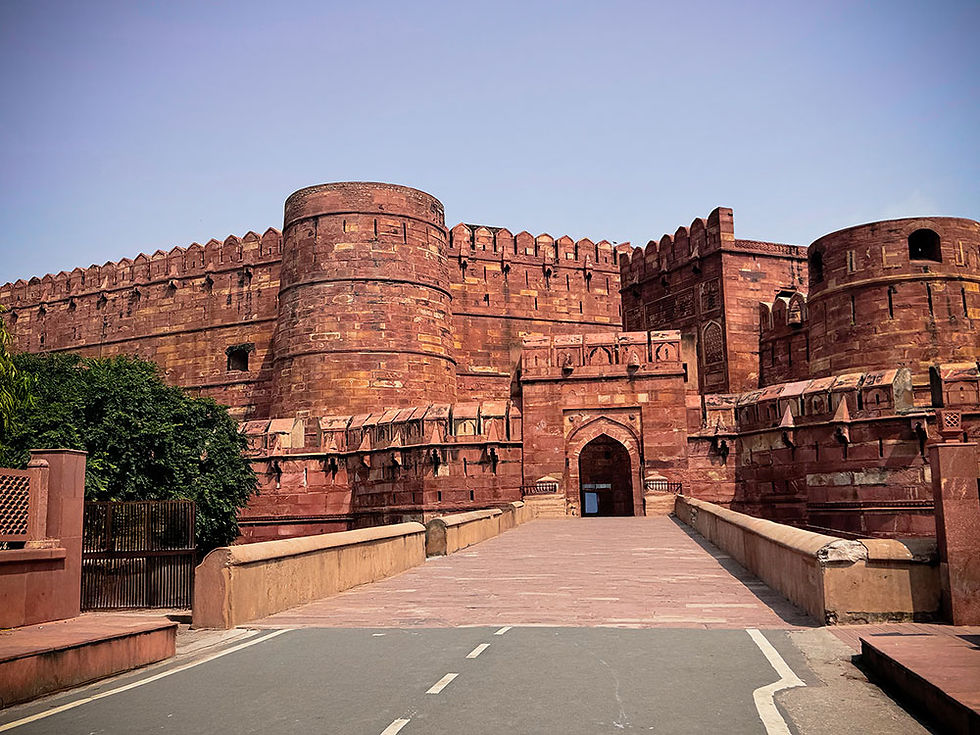
This is crucial because it demonstrates that India’s later subordination was not the inevitable consequence of a civilization already in terminal decline. The weakening of the ancient Golden Age between roughly AD 1000 and 1300 did not produce a continuous, irreversible descent into poverty or insignificance.
India recovered.
It became rich again.
It became globally important again.
That is why British colonial rule represents a far more decisive reversal.
India was progressively incorporated into an imperial economic system designed primarily around British strategic and commercial interests. A country famous for exporting high-value manufactured goods—particularly textiles—became increasingly tied to the supply of raw materials and the consumption of British industrial products.
Revenue, trade policy and imperial power were redirected in ways that helped strengthen Britain while constraining India’s own economic autonomy. India shifted from being a global producer of high-value textiles and manufactured goods towards an economy increasingly subordinated to British industrial interests, supplying raw materials and consuming British manufactures.
India’s global power was not merely lost.
It was redirected to help finance the rise of industrial Britain.
For me, this is why the end of India’s Golden Age matters. It challenges the comforting idea that great civilizations simply rise, flourish and naturally decline. India’s global position was transformed by identifiable historical forces: the weakening of Buddhist institutions, Turkish conquests, the destruction of major centres of learning such as Nalanda, changing trade routes, the expansion of Islamic maritime networks, the Mongol reorganisation of Eurasia and the rise of China as a competing economic power.
Yet the story did not end there. The Mughals later rebuilt India into one of the world’s richest manufacturing and commercial centres, proving that the earlier decline was neither complete nor irreversible. British colonial rule then marked a different and more decisive transformation by subordinating much of India’s economic structure to the strategic and industrial priorities of an overseas empire.
As I researched this long historical journey, I came to see India’s story not as a simple rise and fall, but as a series of transformations. The ancient intellectual and Buddhist world weakened. New Islamic political and commercial networks emerged. The Mongols reshaped Eurasia. China rose. The Mughals rebuilt Indian wealth within a new imperial order. Britain then redirected much of that wealth within a colonial system tied to the rise of industrial Europe.
India’s Golden Age did not end in a single moment.
Its institutions weakened, its networks changed, its competitors rose and its place in the world was repeatedly reshaped.
That is what happened to India’s Golden Age.
To continue reading Series 2 we invite you to join us:


Comments