

BLOG 12: What insights have we gained regarding the links between Southeast Asian countries being the origin of New Zealand’s earliest settlers?
- Kerry Paul

- Apr 19
- 2 min read

The question of where New Zealand’s first settlers originated has long intrigued historians, archaeologists, and geneticists. Recent research and multidisciplinary evidence increasingly point to Southeast Asia as a pivotal region in the story of New Zealand’s earliest inhabitants. This Blog Series synthesizes insights from archaeology, genetics, linguistics, and cultural studies to illuminate the connections between Southeast Asian countries and the origins of New Zealand’s first settlers.
Maritime Networks and Migration
Southeast Asia has been a hub of maritime connectivity for thousands of years, with advanced seafaring skills enabling long-distance voyages across the Pacific. Archaeological evidence suggests that people from Southeast Asia were undertaking oceanic journeys well before 2000 years ago, facilitated by complex trade networks and technological innovations in boat-building and navigation. These networks linked Southeast Asia with India, China, and the Pacific, laying the groundwork for migration routes that eventually brought settlers to New Zealand.

Cultural and Architectural Parallels
One of the most striking connections is found in the architectural similarities between ancient stonework structures in New Zealand and monumental sites in Southeast Asia. The Waipoua Stonework Structures in Northland, New Zealand, share features with Cambodia’s Angkor Wat, including advanced stone construction techniques, ceremonial functions, and intentional landscape integration. Such parallels suggest that the skills and cultural practices of Southeast Asian societies influenced the earliest New Zealand communities.



Artefacts and Technological Exchange
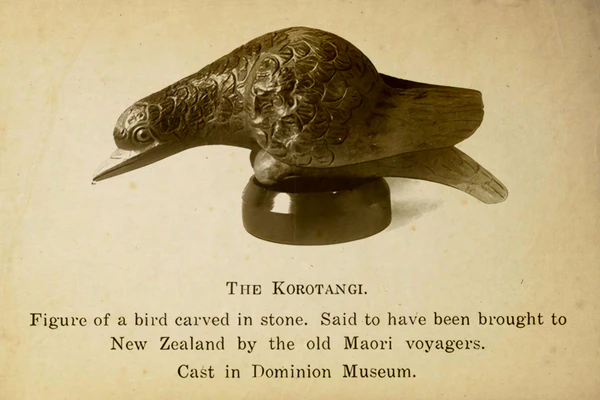
Artefacts discovered in New Zealand, such as the serpentine stone bird carving and the Tamil Bell, further support the Southeast Asian connection. These items, made from materials and using techniques not native to New Zealand, indicate trade or migration from regions like Indonesia, China, and Southern India. Polished stone tools found in New Zealand also resemble those used in Southeast Asian construction, reinforcing the idea of shared technological practices.


Genetic Evidence
Genetic studies provide compelling support for Southeast Asian origins. Mitochondrial DNA analysis reveals that 85% of Māori samples carry a genetic marker characteristic of Southeast Asian populations, while Y-chromosome data shows a mix of Melanesian, European, and East Asian lineages. This genetic diversity reflects multiple migration events and interactions, but the predominant maternal ancestry points to a expansion from Southeast Asia direct to New Zealand and into Polynesia.

Linguistic and Cosmological Connections
Linguistic research highlights similarities between Māori and Southeast Asian languages, particularly through the influence of Sanskrit and other Indian languages on the Malayo-Polynesian family. Cosmological traditions, such as the use of monumental architecture to mark astronomical events, also show parallels between New Zealand and Southeast Asian societies, suggesting shared spiritual symbolism and astronomical knowledge.

Conclusion
The convergence of archaeological, genetic, linguistic, and cultural evidence paints a compelling picture of Southeast Asia as the origin of New Zealand’s earliest settlers. These insights not only deepen our understanding of New Zealand’s past but also highlight the remarkable maritime capabilities and cultural exchanges that shaped the history of the wider Asia-Pacific Region.
What are your thoughts after reading the evidence presented? Who do you think were New Zealand’s first settlers? I’d like to see your comments or have further discussions over email or other mediums.
For further reading on Europeans who reached New Zealand before Abel Tasman refer to New Zealand: Early European Explorers


Comments