

BLOG 13: Did early Polynesian migration to New Zealand involve enough people to ensure long-term population survival?
- Kerry Paul

- 13 hours ago
- 2 min read

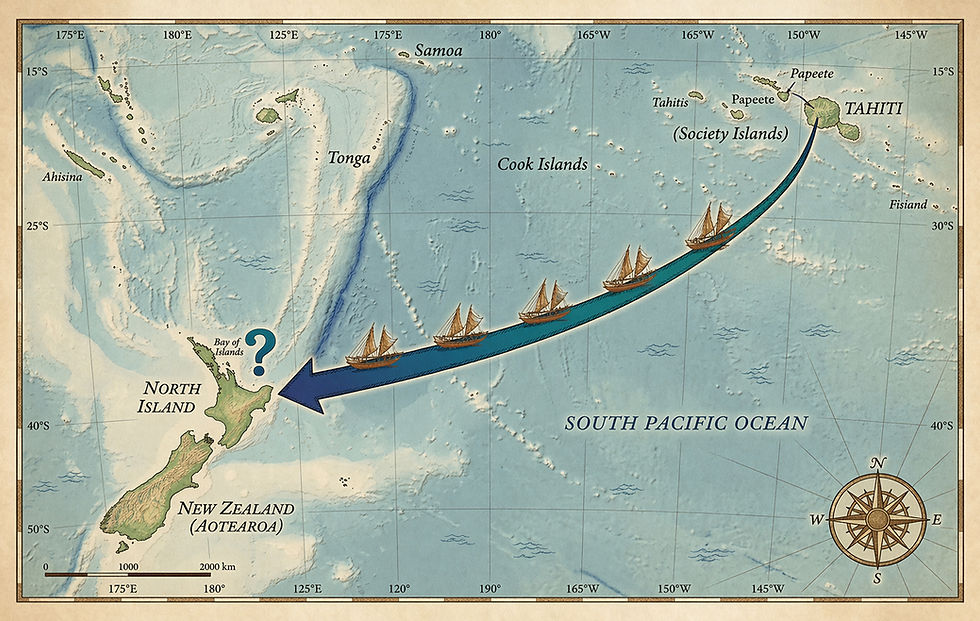
The establishment of a sustainable population requires the presence of women of child‑bearing age. If Polynesian women were absent from the earliest voyages, and if there was no dependable means of returning to Polynesia with confirmation of successful discovery or settlement, an important question follows: on what basis would women have been included in later exploratory voyages? This demographic puzzle is at the heart of New Zealand's origin story.
Since a sustainable population requires the presence of child‑bearing women, then the absence of Polynesian women on the earliest voyages presents a scenario where New Zealand may not have been uninhabited when the first Polynesian waka arrived. In that case, early voyages entered an already occupied landscape, where population continuity existed independently of the Polynesian Migration to New Zealand. Under this scenario, Polynesian settlement represents not a founding moment, but an overlay—contact, integration, and eventual dominance over an existing population. This is a logical scenario resolving the demographic problem of there being no child-bearing women on the earliest voyages. This theory looks toward the possibility of an earlier Southeast Asian Migration to New Zealand to explain who those inhabitants might have been.
Beyond successful arrival, population sustainability for New Zealand's first settlers depended on a complex set of demographic, technological, and cultural requirements. A viable community required sufficient numbers of adults to offset deaths from illness, accidents, and environmental exposure, as well as a balanced mix of ages to ensure knowledge transfer and long‑term continuity; without this balance, survival beyond one or two generations was unlikely. The stories of Kupe and other early explorers give us names, but do not provide the population numbers required for these scientific models.
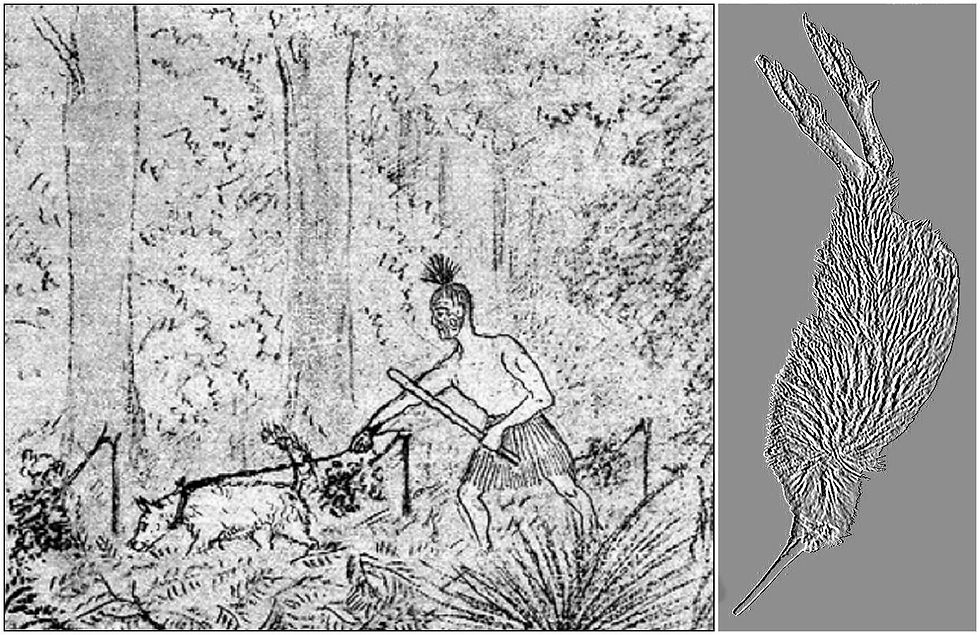
Settlers also needed reliable food systems suited to a cooler, more variable environment, including crops that could adapt to temperate conditions, knowledge of food preservation for extended winters, and hunting and fishing technologies appropriate to unfamiliar species.
Toolmaking posed a further challenge, as imported materials would quickly be exhausted, requiring transported knowledge of tool design, the ability to adapt technologies to local stone, timber, and fibres, and the capacity to manufacture tools locally—capabilities essential to food production, shelter, and safety.

Social sustainability was equally critical: stable populations depended on systems of leadership and cooperation, shared rules governing land use, kinship, and conflict resolution, and effective transmission of knowledge across generations.
New Zealand’s larger scale and harsher climate also demanded construction expertise for durable, weather‑resistant housing, insulation, storage, and the collective labour needed to build and maintain permanent settlements.
Because return or reinforcement voyages were unreliable or effectively blocked, settlers had to arrive fully self‑sufficient, with skills and the capacity to survive without external resupply.
Together, these constraints significantly raised the threshold of what had to be “transported” in human knowledge, organisation, and capability for settlement to succeed.



Comments